

Tally Prime is widely used for recording business transactions, maintaining ledgers, managing inventory and preparing accounting reports. For commerce students, accountants, business owners and job seekers, learning the software can connect theoretical accounting knowledge with everyday commercial work.
Good Tally Prime training in Manjalpur should teach the complete accounting process rather than isolated software commands. Learners need to understand why a transaction is recorded in a particular way and how it affects financial reports.
Build the Accounting Foundation First
Students who know basic accounting often learn Tally faster, but beginners can also succeed when the fundamentals are explained clearly. Before entering complex vouchers, learners should understand:
- Assets, liabilities, income and expenses
- Debit and credit principles
- Ledger creation and grouping
- Capital and drawings
- Purchases and sales
- Receivables and payables
- Profit and loss statements
- Balance sheets
This foundation prevents learners from becoming dependent on memorised steps.
Learn Company and Ledger Configuration
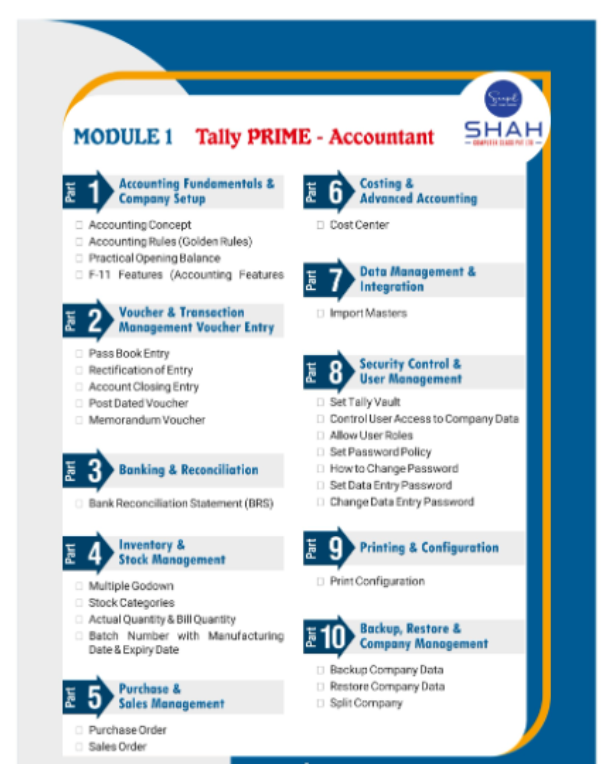
The practical journey usually begins with company creation and configuration. Students should learn how to define financial years, maintain security controls and set relevant accounting features.
Ledger creation requires careful attention because incorrect grouping can affect reports. A trainer should explain how to create customer, supplier, bank, expense, income and tax ledgers using realistic business examples.
Practise Common Accounting Vouchers
Voucher entry forms the core of daily work in Tally Prime. Learners should receive repeated practice with:
- Payment and receipt vouchers
- Contra entries
- Journal entries
- Purchase and sales vouchers
- Debit and credit notes
- Purchase returns and sales returns
- Bank-related entries
- Adjustment transactions
Instead of entering random figures, students should work through connected business scenarios. This helps them understand the full transaction cycle from purchase to payment and from sale to receipt.
Understand Inventory Management
Businesses dealing with goods may need to maintain stock groups, categories, units and individual items. Training should cover purchases, sales, stock movement and inventory reports.
Practical exercises can show how an incorrectly selected item or unit affects stock balances. Learners should also know how to review slow-moving goods, available quantities and item-wise performance when those features are relevant to the business.
Connect Tally With GST Workflows
Accounting roles increasingly require familiarity with GST-related entries and reports. Students should learn how tax configurations affect invoices, purchases and returns-related data.
Training should explain intra-state and inter-state transactions, input and output tax, debit and credit notes, reverse charge situations where applicable, and the importance of accurate party information. Tax rules can change, so learners should verify compliance requirements through current official guidance or a qualified tax professional.
Develop Reporting and Error-Checking Skills
Entering data is only one part of an accountant’s responsibility. Learners must know how to review ledgers, trial balances, outstanding statements, stock summaries, profit and loss accounts and balance sheets.
A practical programme should demonstrate how to locate common errors such as duplicate entries, incorrect dates, wrong ledger selection and mismatched opening balances. Reconciliation exercises are also valuable because real-world records are not always perfect.
Course Value for Different Learners
Commerce graduates can use Tally skills to prepare for junior accounting roles. Existing accountants may update their knowledge and improve reporting efficiency. Entrepreneurs can gain greater visibility into their own financial records, although professional advice remains important for statutory compliance.
For learners in Manjalpur and other commercial areas of Vadodara, training based on realistic local business transactions can make concepts easier to apply. Shah Computer Class Pvt Ltd offers career-oriented learning for students and professionals seeking practical computer and accounting skills.
Before enrolling, ask whether the course includes assignments, GST-related practice, reporting exercises and assessments. A worthwhile programme should enable you to create accounts, record transactions, check reports and identify basic errors independently. That practical confidence is what turns software familiarity into an employable accounting skill.