

Students often face a choice between learning one skill deeply, collecting unrelated certificates, or following a longer academic route. By the end, you will be able to identify complementary skills, match them to a target job, compare learning formats, and judge whether a combo course provides genuine workplace practice.
Key takeaways
- Choose skills that follow the workflow of your target job.
- Check for projects using shared data across accounting, tax and spreadsheets.
- Compare practical output, feedback and practice time—not course labels.
- Finish with work samples that demonstrate accurate, repeatable performance.
What a Combo Course Teaches That Separate Short Courses Miss
A combo course connects multiple professional skills to one workplace workflow; separate short courses often leave you with isolated techniques and no practice moving information between them. That difference matters when a junior employee must turn a transaction into a reliable report, not merely enter data or format a spreadsheet.
A realistic case should follow the same transaction through this sequence:
- Source document and transaction review
- Journal entry and ledger posting
- Bank reconciliation and error correction
- Trial balance and financial statement preparation
- Tax treatment and supporting documentation
- Management report or spreadsheet schedule
This workflow coverage shows how an accounting entry affects reconciliation, reporting and tax work. It also exposes mistakes that unrelated exercises hide: a duplicated payment, an unmatched bank item or a tax adjustment that changes the final figure.
Practical computer training becomes more useful when spreadsheet work supports the accounting process rather than sitting in a separate module. You should clean imported data, use formulas that check balances, create a report and explain how you reached the result.
The same principle applies to accounting software: understanding the transaction cycle transfers across versions better than memorising menu locations. A completed case therefore proves more than a certificate listing several modules. It shows whether you can process imperfect information, document decisions, protect confidential records and deliver accurate work by a deadline.
Build the Skill Sequence Around the Job You Want
Start with the vacancy, not the course catalogue. Identify the tasks named in the entry-level role, then arrange skills in the order that work actually happens: collect data, classify transactions, check balances, prepare reports, and explain the result.
Use this sequence when choosing complementary skills:
- For MIS executive skills, learn Excel data cleaning, structured tables, formulas, lookups, pivot tables, and report design before dashboard tools.
- For data analyst skills, learn spreadsheet logic and data validation before SQL, visualisation, or automation; otherwise you may display incorrect data neatly.
- For an accounts executive course, learn debit-credit rules, ledger posting, bank reconciliation, and accounting software before GST entries and return preparation.
- For GST consultant skills, learn invoice classification, input-tax-credit checks, reconciliation, and filing workflow before relying on software-generated figures.
| Role | Learn first | Add next | Practical outcome |
|---|---|---|---|
| MIS executive | Excel and data cleaning | Pivot tables, dashboards, automation | Monthly MIS report |
| Junior data analyst | Spreadsheet logic and error checks | SQL, charts, dashboard tools | Cleaned dataset with insights |
| Accounts executive | Accounting principles and software workflow | Bank reconciliation, Excel schedules, GST | Reconciled books and tax records |
| GST support executive | Sales and purchase classification | GST reconciliation and return process | Checked records ready for filing |
Choose process understanding over menu memorisation because Tally Prime and other software change screens, settings, and report locations. Test the sequence with one imperfect case: correct errors, reconcile balances, produce a report, and explain each decision. A broad combo course suits entry-level work; specialist audit, litigation, or advanced ERP roles require deeper study.
Combo Courses Versus Single Skills, Degrees and Self-Paced Learning
A combo course is the better choice when an entry-level job requires one workflow across several tools, not mastery of one isolated skill. A junior accounts employee may collect invoices, record journal entries, reconcile bank data, prepare an Excel schedule and use the figures in a GST or management report.
| Option | Best choice when | Limitation compared with a combo course |
|---|---|---|
| Combo course | You need connected skills in accounting, spreadsheets, tax and finance for practical office work | Breadth versus depth: it may not prepare you for audit, tax litigation or advanced ERP administration |
| Single-specialisation course | You already understand the wider workflow and need deep expertise in one area | It can leave gaps between tasks, such as recording transactions and producing reports |
| Separate standalone courses | You can plan the sequence, check overlap and practise linking every skill | Unrelated courses often teach disconnected exercises |
| Degree programme | You need an academic qualification, theory and eligibility for roles requiring a degree | The degree versus professional course choice favours a combo course when immediate, task-based workplace ability matters more than a formal credential |
| Self-paced online learning | You are disciplined enough to schedule practice, verify accuracy and solve problems without regular feedback | Progress can stop at video completion without correction or assessed work |
Choose a combo course over separate courses when it follows one transaction from source document to journal, ledger, reconciliation, financial statements and tax treatment. Choose a single-specialisation course instead when your target role demands expert depth, such as financial modelling or payroll compliance.
Self-paced online learning suits a narrow gap; a combo course suits a connected entry-level workflow.
How to Check Whether a Combo Course Is Truly Practical
A practical combo course leaves you able to complete a work sequence, not merely tick off modules. Check that the syllabus moves from spreadsheet and accounting foundations to automation, tax work and reporting; otherwise you may copy outputs without spotting a wrong classification.
Before enrolling, ask for:
- The number of lab hours, hands-on projects and graded practice tasks, including imperfect transaction data rather than prepared examples.
- The exact software and versions included in your software access, plus whether you practise data cleaning, lookups, conditional logic, error checks, pivot tables and reconciliation formulas.
- A course assessment that requires ledger posting, bank reconciliation, error correction, tax classification checks, supporting-document review and final reports.
- Transaction-level feedback from an instructor, not only marks for submitting a file.
- The method used to handle GST and other tax updates: dated software changes, revised examples and explanations of new rules.
| Check | Weak sign | Practical sign |
|---|---|---|
| Syllabus | Separate modules with no workflow | Collect data, record transactions, reconcile, report and file |
| Projects | One polished case | Several cases containing missing or incorrect entries |
| Tax software | Submit a return | Validate totals, credits, classifications and exceptions before filing |
| Assessment | Multiple-choice quiz | Correct errors and explain each decision |
Ask to see a sample rubric. It should award marks for accurate reconciliation, documented corrections and clear reasoning. Shah Computer Class Pvt Ltd is one provider you can question using these same checks rather than judging a combo course by its module count.
Related products
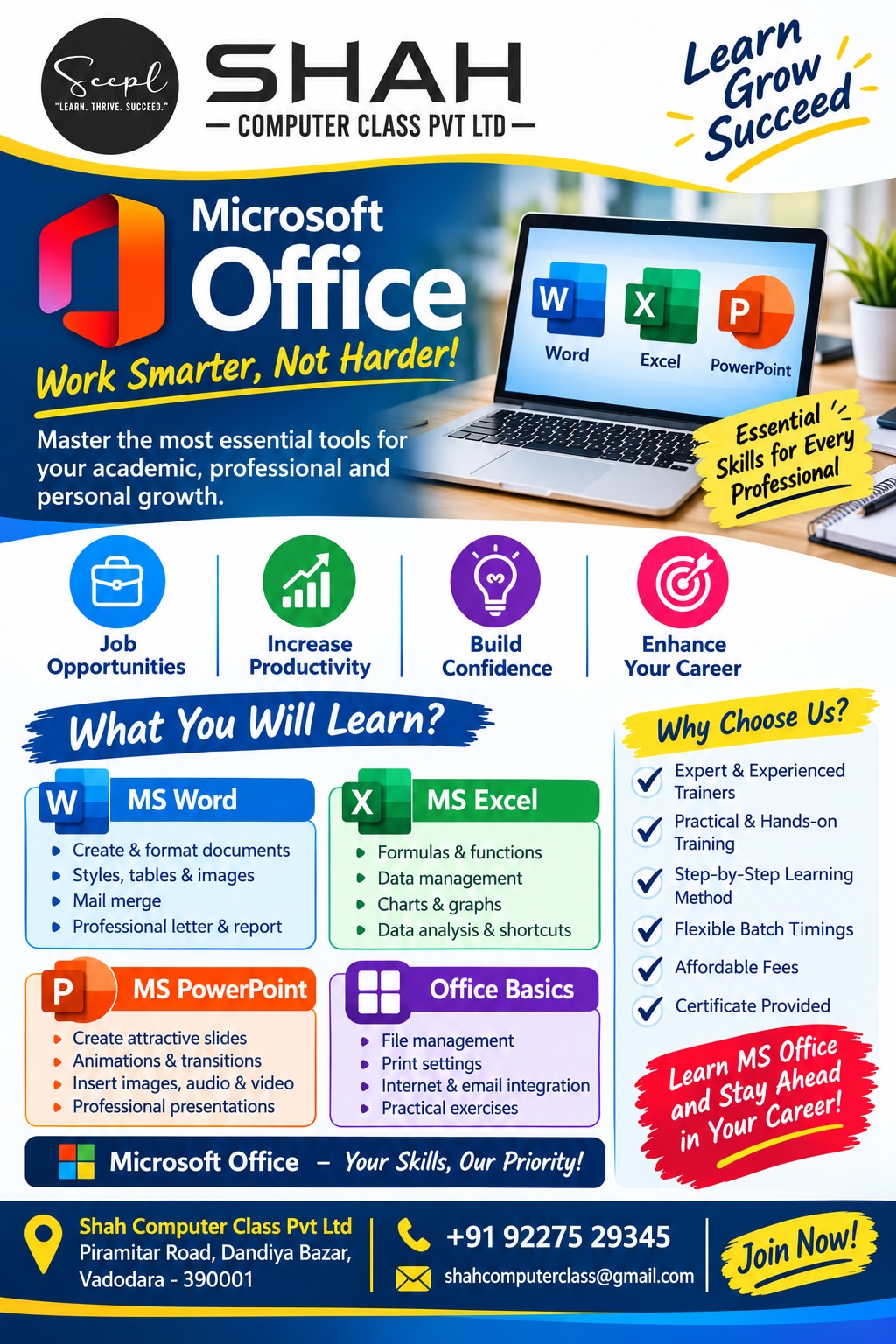 | 🔹 MS Office Course (Basic to Advanced) 🔹 MS Office Course (Basic to Advanced) ₹7000 Learn MS Word, Excel, PowerPoint and office tools for daily professional work. Ideal for students and job seekers. View product → |
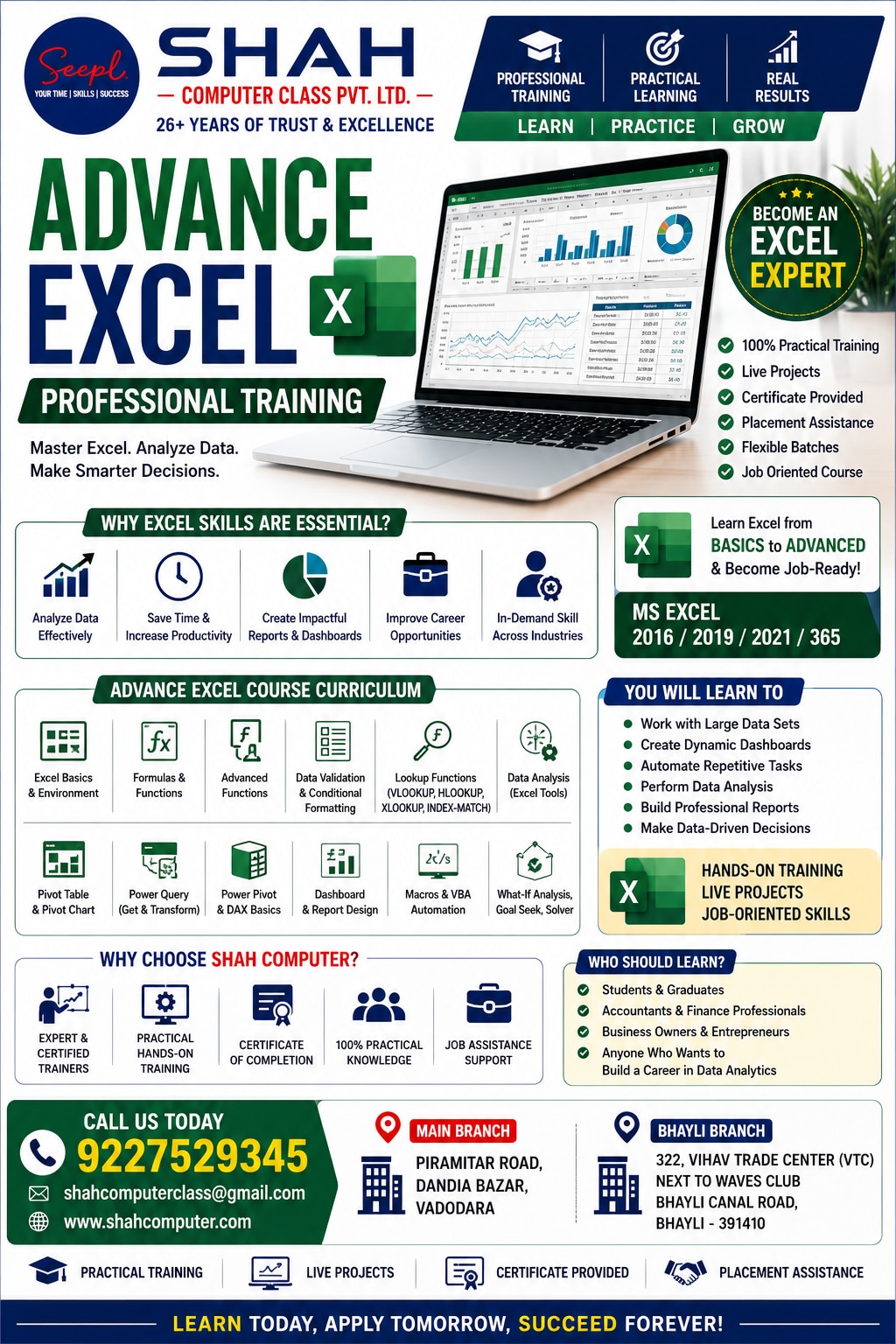 | 🔹 Advanced Excel Course (Corporate Level) 🔹 Advanced Excel Course (Corporate Level) ₹10000 Upgrade your skills with Advanced Excel training. Learn formulas, pivot tables, dashboards, MIS reports, and data analysis tools used in corporate... View product → |
The Evidence of Job Readiness You Should Finish With
A completed case file is stronger proof of job readiness than a completion certificate. It should show that you handled imperfect transactions from source documents to final reports, made corrections, and explained why each decision was appropriate.
Your professional skills portfolio should include:
- An accounting reconciliation that matches ledger balances with bank records, identifies unreconciled items, and documents the resolution.
- GST filing practice showing ledger totals agreeing with return totals, consistent tax classifications, supported input credits, and reviewed exceptions before submission.
- Spreadsheet work using cleaned data, structured tables, lookups, conditional logic, pivot tables, and reconciliation formulas rather than formatting alone.
- An error correction log that records the original mistake, corrected entry, reason for the change, and effect on the report or tax calculation.
- A management report or MIS schedule produced from the same accounting data, with clear file names, formulas, assumptions, and version dates.
The work should also demonstrate practical discipline: protecting confidential data, meeting a stated deadline, and keeping an audit trail of source documents and changes. Ask whether an assessor reviewed transactions individually, not just whether the final file opened successfully.
You should be able to explain a reconciliation difference, tax adjustment, or rejected input credit without reading a prepared answer. That explanation proves the skills are usable, not merely completed.
Frequently asked questions
What does a combo course teach that separate short courses miss?
It connects skills through one workplace workflow, so you practise moving information from transactions to spreadsheets, reports and decisions.
How should you sequence skills in a combo course?
Start with the tasks your target job requires, then order the skills from source data and processing to checking, reporting and communication.
How do combo courses compare with single skills, degrees and self-paced learning?
Combo courses link several job tasks in one programme; single-skill courses go deeper in one area, degrees provide broader academic study, and self-paced learning requires you to design and manage the sequence.
How can you check whether a combo course is truly practical?
Look for realistic datasets, guided projects, software practice, instructor feedback, error correction and assessments that produce usable work.
What evidence of job readiness should you finish with?
Finish with work samples such as reconciled records, accurate spreadsheets, tax or finance reports, project files and a clear explanation of your process.
Related products
 | 🔹 Data Analytics Certification Course 🔹 Data Analytics Certification Course ₹54000 🔹 Data Analytics Course Become a skilled Data Analyst with our industry-focused Data Analytics Course designed for students, job seekers, working... View product → |
 | 🔹 AI Course in Vadodara (AI Expert in 30 Days) 🔹 AI Course in Vadodara (AI Expert in 30 Days) ₹20000 AI Expert in 30 Days – Professional Course Become an AI expert with practical training in the latest Artificial Intelligence tools and automation... View product → |
 | 🔹 US EA, US CPA, US CMA , US ACCA COURSE 🔹 US EA, US CPA, US CMA , US ACCA COURSE ₹60000 🔹 US EA (Enrolled Agent) Course US EA (Enrolled Agent) is one of the most demanding international taxation certifications recognized by the IRS... View product → |
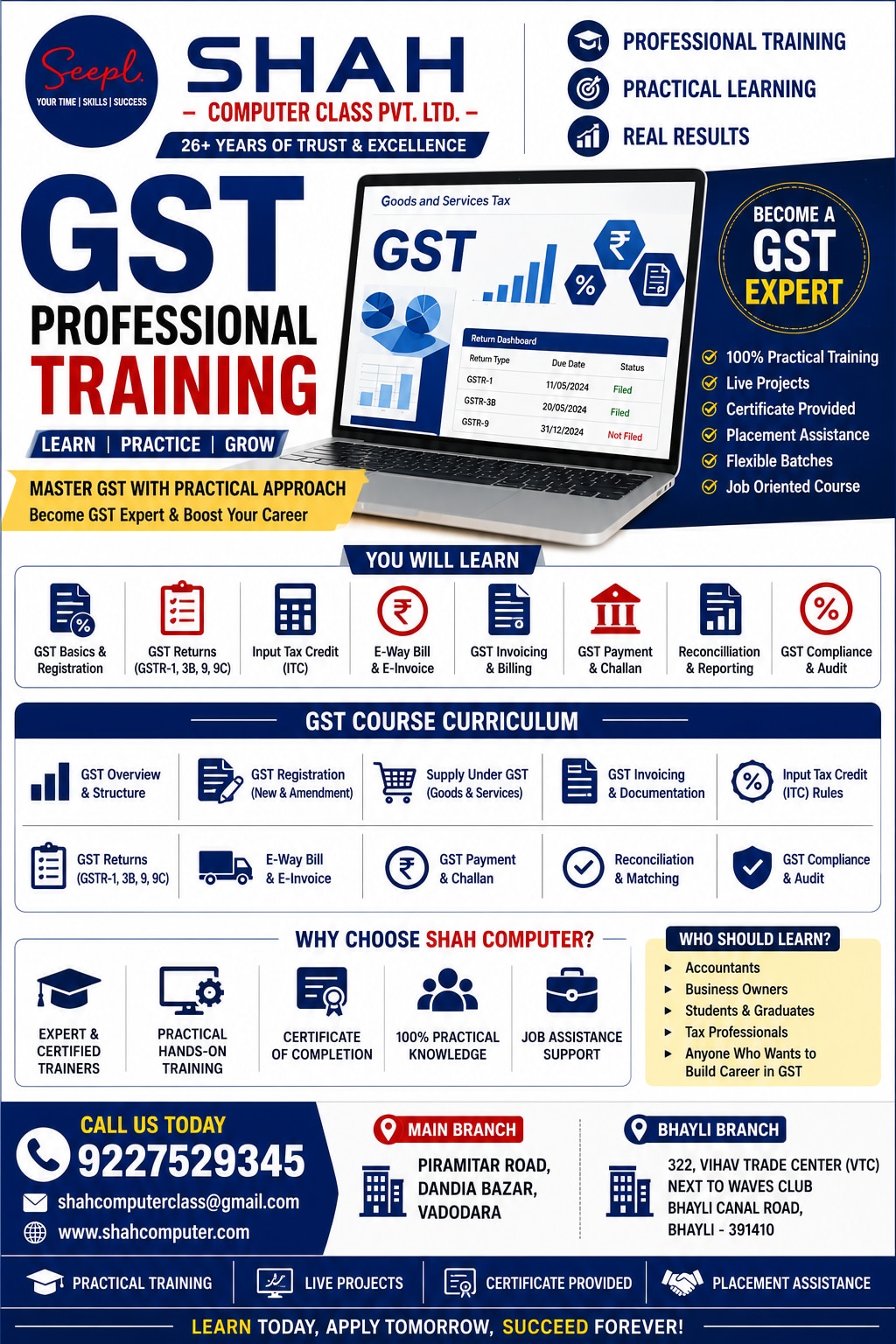 | 🔹 GST Consultant Course in Vadodara 🔹 GST Consultant Course in Vadodara ₹12500 ## GST Consultant Course – Practical GST Training with Tally Prime Become a professional GST consultant with our industry-oriented **GST Consultant... View product → |