

Choosing SAP FICO training requires more than finding a course that teaches journal-entry screens. You need to know whether the programme builds FI and CO understanding, provides practice in SAP S/4HANA, and prepares you to trace transactions, resolve errors, reconcile balances, and support period closing.
Key takeaways
- FI records statutory transactions; CO analyses internal costs and profitability.
- Learn company codes, controlling areas, ledgers, cost centres, and profit centres.
- Trace a vendor invoice through payment, reconciliation, and financial statements.
- Compare practice systems, trainer experience, projects, and assessment before enrolling.
What SAP FICO Covers and How FI Connects with CO
SAP FICO is an integrated finance framework, not one standalone module. Financial Accounting (FI) records transactions for statutory reporting, while Controlling (CO) explains internal costs, profitability, planning, and management performance.
FI work covers these connected areas:
- General ledger: posts journal entries and produces the trial balance and financial statements.
- Accounts payable: records supplier invoices, tax, and vendor payments.
- Accounts receivable: records customer billing, receipts, and outstanding balances.
- Asset accounting and bank accounting: tracks fixed assets, depreciation, bank transactions, and reconciliation.
CO assigns costs and revenues to the business objects managers use to analyse performance:
- Cost centre: measures spending by department or responsibility area.
- Internal order: tracks a temporary activity, event, project, or campaign.
- Profit centre: compares revenue, cost, and result for a business unit.
The connection begins when an FI document is posted. A supplier invoice updates the vendor subledger and general ledger, while its cost assignment sends the expense to a cost centre or internal order. A customer invoice can update a profit centre and support profitability analysis.
In SAP S/4HANA, the Universal Journal in SAP S/4HANA stores FI and CO line items in one central record. That shared data reduces reconciliation between financial and management accounting, but errors still arise from missing master data, invalid periods, authorisations, or incompatible account assignments—not only from incorrect typing.
The SAP Organisation Structure and Finance Areas You Must Learn
A posting is valid only inside the right SAP structure. The company code defines the legal reporting entity; the chart of accounts defines available G/L accounts; the fiscal year variant controls periods; and posting periods decide when entries are open. Ledgers determine reporting views, while the controlling area links cost management across assigned company codes.
| Area | Core objects | What you must understand |
|---|---|---|
| FI structure | Company code, chart of accounts, fiscal year variant, ledgers, posting periods | Which dates, currencies, accounts, and reports accept a posting |
| FI master data | G/L accounts, customer and vendor records, asset masters, bank accounts | How reconciliation accounts, payment data, tax settings, and account status control entries |
| CO structure | Controlling area, cost centre, profit centre, internal order | Where costs belong, how temporary spending is tracked, and how responsibility is reported |
| Transaction areas | General ledger, accounts payable, accounts receivable, asset accounting, bank accounting | How subledger entries update the G/L and financial statements |
Practise document types and tax codes alongside master data. A failed posting can result from missing authorisation, a closed period, incomplete vendor or G/L data, an invalid account assignment, or configuration—not just a typing error.
Trace each transaction from source document to accounting document and report: record the document number, company code, posting date, document date, currency, tax code, account assignment, and clearing status.
In S/4HANA, the Universal Journal connects many FI and CO postings. For Indian finance work, test input and output GST, credit notes, applicable reverse charge, and GST reconciliation; SAP tax-code configuration does not replace return filing or government e-invoice reporting and Invoice Reference Number generation.
A Practical FI Workflow from Vendor Invoice to Financial Statement
A purchase transaction becomes a complete FI record only when SAP connects the vendor invoice, tax, payment, general ledger, and reports. The workflow begins in accounts payable and ends with a cleared liability that appears in financial statements.
1. Create or verify the vendor master, including payment terms, reconciliation account, withholding-tax details, and bank data. The vendor account remains a subledger record linked to the general ledger.
2. Enter the supplier invoice with the company code, document date, posting date, currency, expense or inventory account, and cost centre or internal order. Select the correct tax code so SAP calculates input tax and posts the vendor liability and tax amounts separately.
3. Review the accounting document before posting. Check the document number, debit and credit values, tax base, account assignment, and posting period; an incorrect tax code or closed period can distort both the invoice and later reporting.
4. Run the payment proposal after the invoice is due, approve exceptions, and post the outgoing payment. Bank accounting records the bank movement, clears the vendor item, and reduces the payable balance.
5. Reconcile the vendor subledger with the reconciliation account in the general ledger, then review the journal and financial statements. In SAP S/4HANA, many FI and CO postings feed the Universal Journal, supporting drill-down from report totals to source documents.
Posting GST in SAP does not complete compliance. For covered transactions, electronic-invoice reporting and Invoice Reference Number generation occur through the government system, followed by applicable GST return filing.
How CO Tracks Costs, Allocations, Variances, and Management Results
A CO report becomes useful when every actual cost has an accountable owner, a planned amount, and a clear business purpose. SAP connects postings from FI with controlling objects, allowing managers to compare spending, investigate exceptions, and assess results without relying on isolated transaction codes.
- A cost centre records recurring costs for a department, such as rent, salaries, or administration.
- An internal order collects temporary or project-specific spending, such as an office move, campaign, or repair.
- A profit centre groups revenue and cost by a business area, product line, or location to show operating performance.
- A budget sets the approved spending limit or planned revenue for the selected object and period.
Suppose an electricity invoice posts to a cost centre. An allocation cycle can distribute that cost to production departments using a defined basis, such as floor area, headcount, or machine hours. The receiving objects then show a more realistic cost, while the sender and receiver totals remain traceable.
Managers use budget variance analysis to compare planned figures with actual postings. A favourable variance means results beat the plan; an unfavourable variance signals overspending, weak sales, incorrect account assignment, or an unrealistic budget. The report becomes useful only when you can drill into the accounting document, posting date, amount, currency, and assigned object.
During period close, allocations, accruals, and reconciliations update management reports. Profit-centre statements, cost-centre reports, order settlement, and margin analysis then support decisions about pricing, staffing, projects, and cost control.
How to Judge a SAP FICO Course in Karelibaug Before Enrolling
Do not enrol because a brochure says “FICO.” Ask which release you will use: SAP S/4HANA Finance or ECC. Screens, data models, Universal Journal reporting, and reconciliation work differ; confirm whether practice includes both SAP GUI and SAP Fiori where relevant.
Check prerequisites in writing. You need basic double-entry bookkeeping, journals, ledgers, GST concepts, and comfort with Excel; a good provider states whether it teaches these or assumes them. Ask for named SAP access, not screenshots: your own user in a sandbox, resettable data, and enough time to post, reverse, investigate, and report.
| Verify | Acceptable evidence | Warning sign |
|---|---|---|
| Configuration | IMG configuration for company code, chart of accounts, fiscal year, posting periods, document types, tax codes, and account assignments | Only transaction-code demonstrations |
| Integration | FI postings flowing to cost centres, internal orders, profit centres, and the Universal Journal | FI and CO taught as unrelated chapters |
| Indian practice | Input/output GST, credit notes, applicable reverse charge, tax-code tests, and GST reconciliation | One generic tax code |
Demand an end-to-end assessment: procure-to-pay, order-to-cash, asset acquisition, or period close, ending with error diagnosis and a financial report. Ask how the trainer handles authorisation errors, closed periods, incomplete master data, and invalid account assignments—not just typing mistakes.
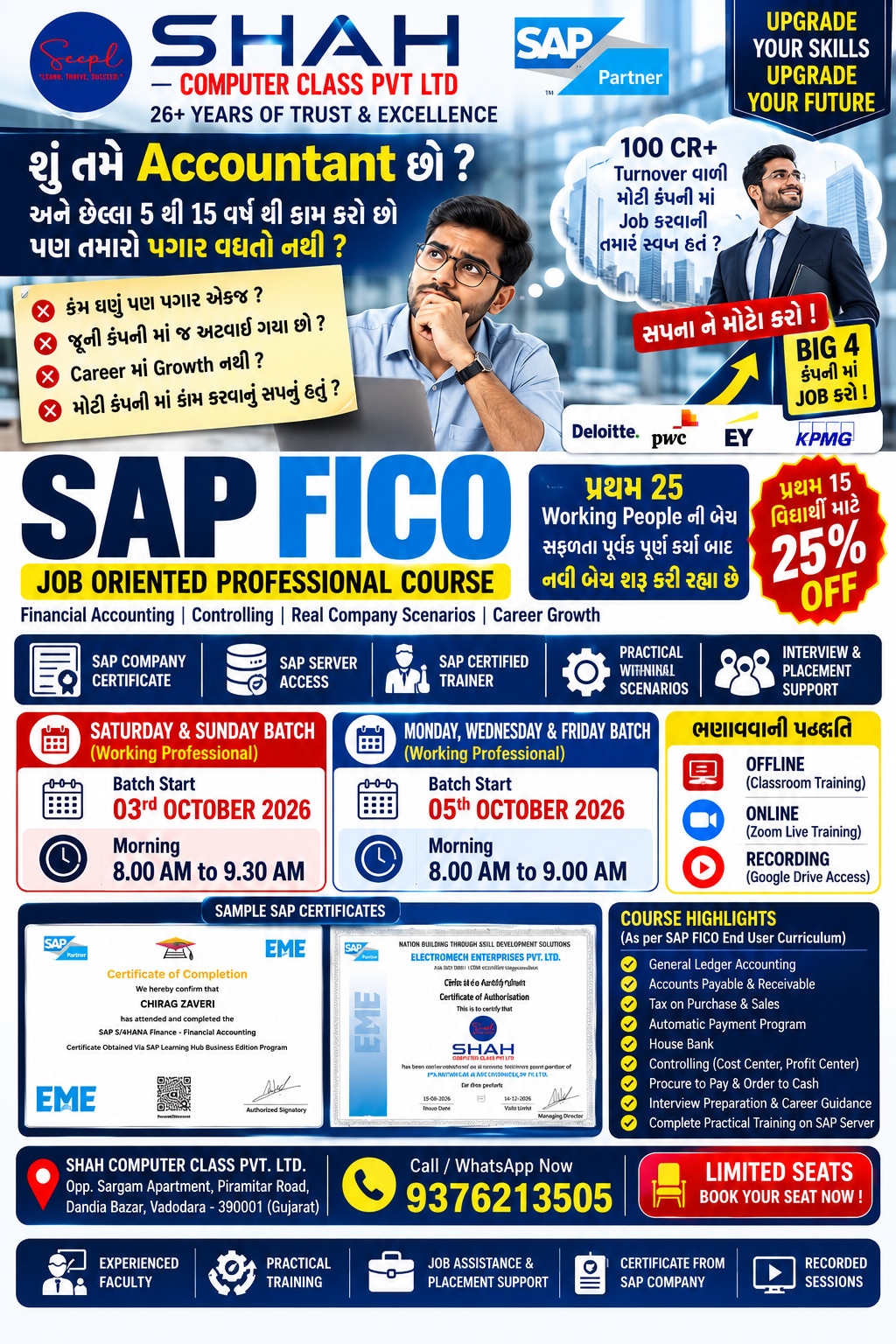
Before enrolling in Karelibaug, Shah Computer Class Pvt Ltd can be judged by the same evidence: inspect a live class or sandbox, ask to see learner work, and verify whether feedback covers configuration and reconciliation. A quiet lab, current system access, and time for questions matter more than polished slides.
Frequently asked questions
What is the difference between SAP FI and SAP CO?
FI records accounting transactions for statutory reporting. CO tracks internal costs, allocations, planning, variances, and profitability for management decisions.
Which SAP organisation structures must you learn for FICO?
You need to understand company codes, controlling areas, ledgers, chart of accounts, fiscal years, cost centres, profit centres, and related finance assignments.
How does a vendor invoice move through SAP FI?
The process records the supplier invoice, posts the liability and expense or asset, clears the payable through payment, reconciles the accounts, and feeds financial statements.
How can you evaluate an SAP FICO course in Karelibaug?
Check whether the course includes hands-on SAP practice, complete FI and CO workflows, realistic projects, trainer experience, assessments, and clear support after training.