

A commerce degree gives you useful accounting and taxation theory, but it does not automatically prepare you to reconcile GSTR-2B, correct invoices or complete a return workflow. By checking your eligibility, accounting foundation, target job and the course’s practical exercises, you can decide whether GST training is the right next step or whether you need broader accounting skills first.
Key takeaways
- B.Com, M.Com and BBA graduates are strong fits for GST training.
- 12th Commerce students can enrol if the institute accepts them.
- Check hands-on practice with GSTR-1, GSTR-3B, e-invoicing and reconciliations.
- Choose training based on your target: job, accounts practice or GST consultancy.
Who can enrol, and who should take a GST course?
B.Com, M.Com and BBA graduates are strong academic fits for GST training, especially for accounts, audit-support and indirect-tax roles. 12th Commerce students and final-year learners can also enrol if the institute accepts them, but an incomplete degree does not meet the completed-graduate route for statutory GST Practitioner enrolment.
Use this decision check before joining:
- Choose a GST course if you are a commerce graduate seeking accounts or tax work, a student targeting audit-support work, a business owner reviewing compliance records, a freelancer preparing invoices, or someone planning to assist a tax professional.
- Join as a working accountant or bookkeeper if you already maintain records but need GST portal, return-preparation and reconciliation skills.
- Expect extra practice if you graduated from another stream. Learn debit and credit, ledgers, trial balance, sales registers and purchase registers before handling GST data.
- Wait for a GST-only course if you cannot prepare a basic ledger or bank reconciliation. Start with accounting fundamentals instead.
The phrase gst consultant course eligibility needs careful interpretation. A private certificate proves course completion; it does not create statutory GST Practitioner status. Rule 83 conditions apply separately, including Indian citizenship, sound mind, solvency and no conviction for an offence, along with applicable enrolment, examination and verification steps.
Who should take a GST course? Choose it when you want practical compliance skills, not merely a certificate. Your foundation must be strong enough to trace an invoice into books and explain each return figure.
What should a commerce graduate already know before starting?
A commerce degree gives you the accounting foundation, but it does not prove you can handle practical GST work. College usually covers journal entries, debit and credit, ledgers, trial balance, financial statements, basic taxation and business transactions.
| College foundation | Practical GST requirement |
|---|---|
| Journal entries and ledgers | Post transactions and trace voucher amounts into ledgers |
| Financial statements | Derive return figures from accounting records |
| Basic taxation | Read invoices and classify CGST, SGST and IGST |
| Business transactions | Record credit notes, debit notes and corrections |
Before enrolling, check whether you can:
- Read sales and purchase invoices, identify the supplier and recipient GSTIN, and separate taxable value from tax.
- Spot an unbalanced trial balance and complete a basic bank reconciliation.
- Use Excel for sorting, filtering, lookup formulas and duplicate checks.
Tally or another accounting system is not compulsory for every GST role, but software practice makes training resemble an accounts office. GST records depend on sales, purchases, payments and adjustment entries, not portal screens alone.
A useful GST course for commerce graduates in Vadodara must go beyond definitions, rate memorisation and exam questions. It should make you correct an invoice error, investigate a mismatch, preserve supporting records and prepare figures from books. That is the difference between GST training for commerce graduates and tax theory.
You can still enrol without this foundation. Choose a course that teaches accounting practice alongside GST; otherwise, GST lessons will not teach the entire accounting cycle.
Which GST skills prove that a course is practical?
A practical GST course proves itself through workbooks, portal tasks and corrected filings—not definitions, rate memorisation or screenshots. For a gst course for bcom students in vadodara, inspect whether learners handle these activities:
| Skill area | Practical evidence | Failure it prevents |
|---|---|---|
| GST setup | Register a taxpayer, maintain the profile and assign user authorisations | Wrong access or outdated taxpayer details |
| Returns | Prepare GSTR-1 for outward supplies and GSTR-3B for summary liability and eligible input tax credit under regular and composition schemes | Copying figures without checking books |
| Reconciliation | Compare the purchase ledger with GSTR-2B and resolve missing, duplicate or amended entries | Treating a match as automatic credit eligibility |
| E-invoicing and e-way bills | Check applicability, generate an invoice-reference number, follow cancellation or amendment limits, and enter document, transport and vehicle details | Valid tax calculations with invalid movement records |
The classroom should follow a complete file:
- Collect invoices, validate GSTINs, classify goods or services, post sales and purchases, and compare ledgers with GSTR-2B.
- Check each credit for a tax invoice, receipt of goods or services, tax payment conditions, return filing, blocked credits and payment-related requirements.
- Practise reverse charge, place of supply, inter-State and intra-State treatment, exports, refunds, notices, interest and late-fee calculations.
- Reconcile e-invoice and e-way-bill data with books, prepare both returns, and save acknowledgements, working papers and explanations for adjustments.
A matching GSTR-2B entry is only a starting point. If the course never makes you investigate an ineligible credit or correct a ledger error, it is not job-ready training.
Which training route matches your career goal?
Choose training by the work you want to perform, not by the word “consultant” on a certificate. A GST course fits indirect-tax compliance, return preparation, reconciliation, registration support and supervised work under a tax professional.
| Option | What you will learn | Best fit |
|---|---|---|
| GST course | GST registration, return workflows, reconciliations and portal practice | Indirect-tax support roles |
| Tally Prime with GST | Vouchers, sales and purchase ledgers, inventory, banking records and accounting data for returns | Accounts-office work |
| Income-tax course | Income computation, deductions, advance tax, returns and direct-tax notices | Individual or business income-tax work |
| Full accounting course | The complete accounting cycle and broader bookkeeping | Accounts-assistant roles |
Choose Tally Prime with GST if you cannot yet turn invoices, payments and inventory movements into reliable books. Choose an income-tax course for direct-tax work; it will not teach GST portal practice. Choose full accounting training if you cannot complete a ledger, trial balance or bank reconciliation.
You can combine routes, but a short GST course is not a complete accounting qualification. For gst training for commerce graduates, compare practical assignments with your target role rather than choosing a certificate alone. Someone comparing a gst course for bcom students in vadodara should also inspect whether the syllabus includes accounting records and reconciliations.
A private course does not make you a tax officer, chartered accountant, advocate or automatically enrolled GST Practitioner. Enrolment and permitted GST Practitioner activities are separate, and the taxpayer remains responsible for submitted information. Work under review when handling unfamiliar classifications, complex place-of-supply cases, blocked credit, export refunds, notices, litigation-sensitive positions or high-value adjustments.
Shah Computer Class Pvt Ltd is one local option to assess against this checklist, including its practical assessment, not a substitute for that checking.
Related products
 | Taxation Course ₹12500 Learn Practical GST Training In Our Instiitute View product → |
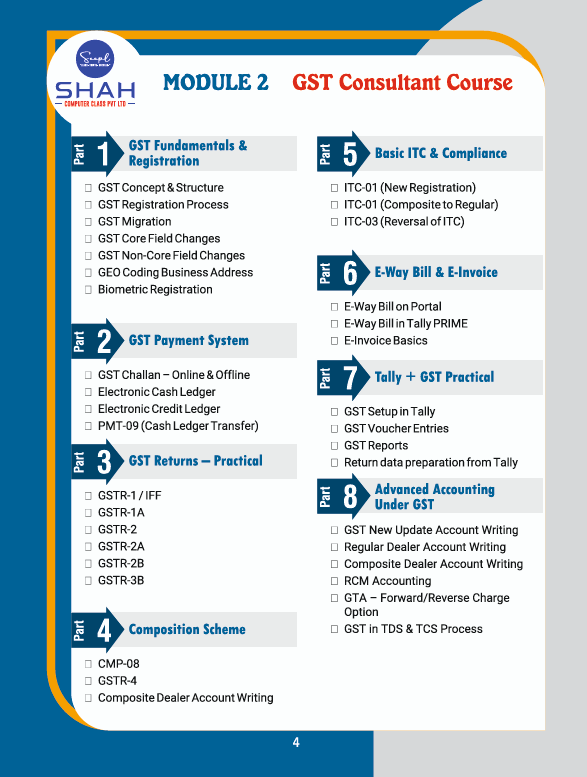 | 🔹 GST Consultant Course in Vadodara 🔹 GST Consultant Course in Vadodara ₹12500 ## GST Consultant Course – Practical GST Training with Tally Prime Become a professional GST consultant with our industry-oriented **GST Consultant... View product → |
How can you test whether the course will make you job-ready?
Ask for the capstone before you pay. A credible gst course for commerce graduates in vadodara should assess a sample Gujarat trading, manufacturing, professional-service or service business, not merely show chapter names.
The exercise should require you to:
- Register a taxpayer, maintain the profile, create sales and purchase invoices, issue credit and debit notes, classify intra-State and inter-State transactions, and prepare the books.
- Validate GSTINs, reconcile purchase records with GSTR-2B, and investigate missing, duplicate and amended invoices.
- Review an e-invoice and e-way bill, then prepare or simulate GSTR-1 and GSTR-3B from the books.
- Calculate interest or late fees, explain every adjustment, and retain filing evidence, reconciliation files and an audit trail.
Ask whether practice uses a current GST portal environment. Confirm that instructor feedback corrects ledger and accounting errors, and that the instructor reviews why outward-supply figures in GSTR-1 differ from summary-return figures in GSTR-3B.
Use this comparison before enrolling:
| Decision sign | What it shows | Action |
|---|---|---|
| Complete capstone with reviewed files | Demonstrable job skills | Consider enrolling |
| Portal screenshots only | Little evidence of accounting ability | Ask for practical assessment |
| No ledger or reconciliation foundation | GST work will be difficult | Learn bookkeeping first |
| Need direct-tax or full accounts training | GST is too narrow | Choose a broader course |
For a B.Com graduate seeking an accounts or tax-support role, this is when who should take a gst course becomes clear: choose it if the tasks fill a real skills gap. Check gst consultant course eligibility separately; “consultant” and “certificate” do not prove competence.
Frequently asked questions
Who should take a GST course?
B.Com, M.Com and BBA graduates are strong candidates for accounts, audit-support and indirect-tax roles. 12th Commerce students and final-year learners can also enrol if the institute accepts them.
What should a commerce graduate know before starting GST training?
You should understand debit and credit, journal entries, ledgers, trial balance, invoices, purchase and sales records, and basic input tax credit concepts.
Which practical GST skills should a course teach?
Look for practice with GST registration details, tax invoices, HSN and SAC codes, GSTR-1, GSTR-3B, e-invoicing, e-way bills, input tax credit reconciliation and error correction.
Does completing a GST course make someone a GST Practitioner?
No. Course completion alone does not create statutory GST Practitioner enrolment. Check the eligibility rules and documentation required for the GST Practitioner route before enrolling.
How can you test whether a GST course is job-ready?
Ask to see the syllabus, software practice, sample assignments and assessment method. Confirm that you will prepare returns, reconcile purchase data and correct realistic GST errors.