

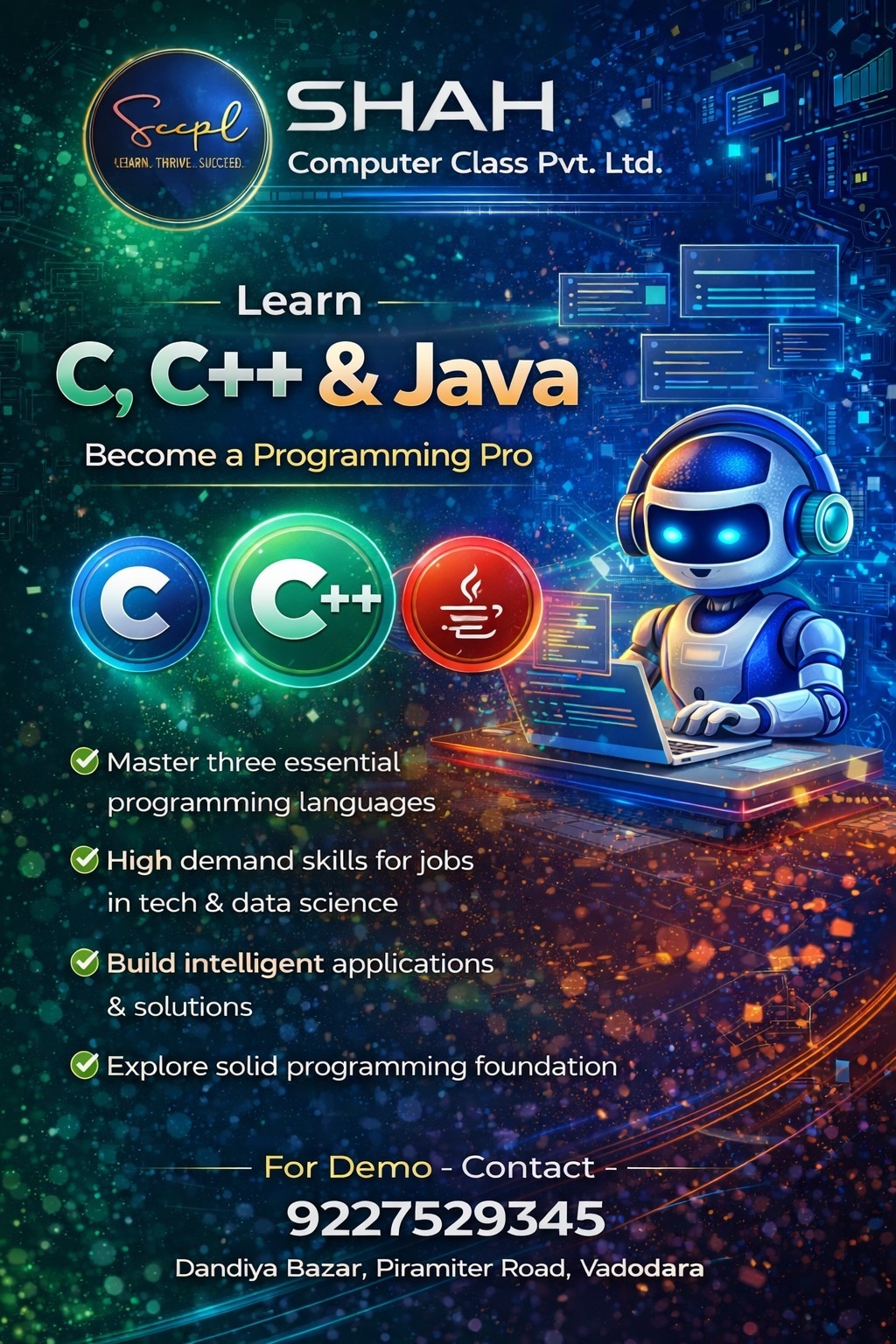
Choosing among C, C++ and Java depends on whether you want embedded programming, performance-focused software, Android development, backend systems, competitive programming, or a broader first step into coding. By the end, you will know what each syllabus should contain, which practical tests reveal genuine skill, and which questions to ask before enrolling in a Manjalpur course.
Key takeaways
- Choose C for foundations, C++ for abstraction, and Java for JVM-based application development.
- Demand compiler setup, version control, debugging, testing and command-line practice.
- Judge a course by working projects, code reviews and timed assessments—not language counts.
- Compare classroom support, project depth and feedback with self-study and online alternatives.
Which language fits your programming goal?
Your goal matters more than the number of languages listed in a brochure. C gives you procedural programming, direct memory control and native compilation; C++ adds abstraction while preserving speed; Java manages memory and runs bytecode on the Java Virtual Machine.
| Language | Best fit | Choose it when |
|---|---|---|
| C | Operating systems, firmware, microcontrollers and embedded devices | You want a low-level foundation and need to understand memory, compilation and hardware control |
| C++ | Game engines, graphics, trading tools and performance-oriented software | You need speed with classes, templates and other abstractions; it also suits competitive programming classes |
| Java | Enterprise applications, Android development, backend services and large JVM-based systems | You want object-oriented application development with managed memory |
Choose C for embedded work or a strong foundation in how programs use memory. Choose C++ for competitive programming and software where performance matters. Choose Java for Android, backend or enterprise development; its managed memory often makes it a smoother first choice for application building.
A C programming course Manjalpur, C++ programming course Manjalpur or Java programming course Manjalpur should provide enough practice in one language to build and debug real programs. Do not choose a short course merely because it lists all three: dividing limited lab time among them can leave you with syntax knowledge but no working skill.
What should the C, C++ and Java syllabus actually teach?
A complete C syllabus should progress from variables, data types, operators, conditions and loops to functions, arrays, strings, structures, pointers, dynamic allocation, file handling and memory debugging. It should expose buffer overruns, use-after-free, memory leaks and invalid pointer dereferences.
| Language | Syllabus that should be present |
|---|---|
| C | Procedural programming, compilation, pointers, structures, dynamic memory, files and debugging |
| C++ | Classes, constructors, destructors, inheritance, polymorphism, references, RAII, C++ STL and templates |
| Java | Classes, Java collections and interfaces, packages, exceptions, streams or file I/O, multithreading and the Java Virtual Machine |
Ask whether the C++ course names its standard, such as C++17 or C++20, and teaches vector, list, map, unordered_map, algorithms and exception safety. Teaching only C-style arrays, pointers and classes leaves out modern C++.
Java training must state its release target because language features and libraries differ between releases. It should also cover class files, compiling, running and diagnosing class-path or module-path errors.
Variables, loops, functions, arrays and compilation carry from C into C++ and partly into Java. Pointers, manual free(), pointer arithmetic and direct memory ownership do not transfer to Java, which uses garbage collection. Java still requires deliberate closing of files, sockets and database connections, commonly through try-with-resources and AutoCloseable.
What software setup and debugging practice will you receive?
Your setup should include a C compiler and debugger, a C++ IDE or code editor, and a repeatable build command. Compile with warnings enabled, set breakpoints, inspect memory and run the debugger; printed output alone will not show where a pointer went wrong.
For Java, install a Java Development Kit and configure JAVA_HOME and PATH when required. Use an editor or IDE, compile source into class files, and run those files on the JVM. Practise fixing class-path and module-path errors instead of hiding them behind one-click execution.
A practical debugging checklist includes:
- Read the first compiler error, reduce the failing input, set a breakpoint, trace variable values and test one assumption at a time.
- Diagnose invalid pointer dereferences, buffer overruns, use-after-free and memory leaks in C and C++.
- Distinguish a Java compilation error from a runtime exception, then use the stack trace to find the failing class and line.
- Use tests, version control and a debugger independently rather than copying an instructor’s steps.
Ask how much lab time covers these tasks. A course that never makes you reproduce and fix failures teaches syntax, not reliable programming.
Which projects and assessments prove that you can code?
Ask for at least three independently written programming projects, not a certificate based on attendance or copied demonstrations. The projects should prove that you can design, test, debug and explain working code.
- C: A command-line billing system or file-processing utility using structures, pointers, input validation and persistent records.
- C++: An inventory programme or student record manager using classes, STL containers, algorithms, file handling and exceptions.
- Java: A REST-style Java application using packages, collections, exception handling, input validation and a database or file-backed service.
Every project needs a written problem statement, source code, test cases, deliberate error handling and a review of design decisions. Ask whether the review checks boundary inputs, failed file operations and invalid records instead of only checking whether the demonstration runs.
Container choice should appear in a practical C++ assessment:
| Container | Strength | Trade-off |
|---|---|---|
| vector | Constant-time random access | Middle insertion generally takes linear time |
| list | Efficient insertion with a known position | No constant-time random access |
| map | Ordered key-value lookup | Logarithmic operations |
| unordered_map | Average constant-time key lookup | No ordering; hash-table collisions affect performance |
Assessments should test C pointers and dynamic allocation, C++ container choice, and Java collections, resource management and concurrency basics. You should explain and modify your own code under review, not merely reproduce the instructor’s screen.
What course format should you verify before enrolling in Manjalpur?
Ask for the exact course duration, weekly programming batch schedule, total practical lab hours, maximum batch size and the number of computers available. Also get the missed-class recovery policy in writing; a recorded explanation is not equivalent to supervised practice.
1. Confirm the entry requirements: basic computer use, mathematics expectations, prior coding experience and whether you must bring a laptop. Ask how many sessions involve independent coding rather than watching demonstrations.
2. Ask how quickly an instructor reviews compiler and debugging errors, and whether project reviews happen one to one or only through group demonstrations. A trial lab session can reveal whether students write code themselves and receive help tracing errors.
3. Request the complete programming course fees Manjalpur quote in writing. Check whether it includes computer lab access, compiler or IDE setup, project review, tests, revision sessions and an independently verifiable certificate.
4. If comparing Shah Computer Class Pvt Ltd with other Vadodara providers serving Manjalpur learners, ask each provider the same questions instead of relying on the course title. Treat placement assistance as a service description unless the provider supplies a dated placement denominator, defines a successful outcome and names the roles counted.
A practical course should let you use a compiler or build tool, debugger, version control and tests. Attendance alone proves neither coding ability nor project ownership.
Related products
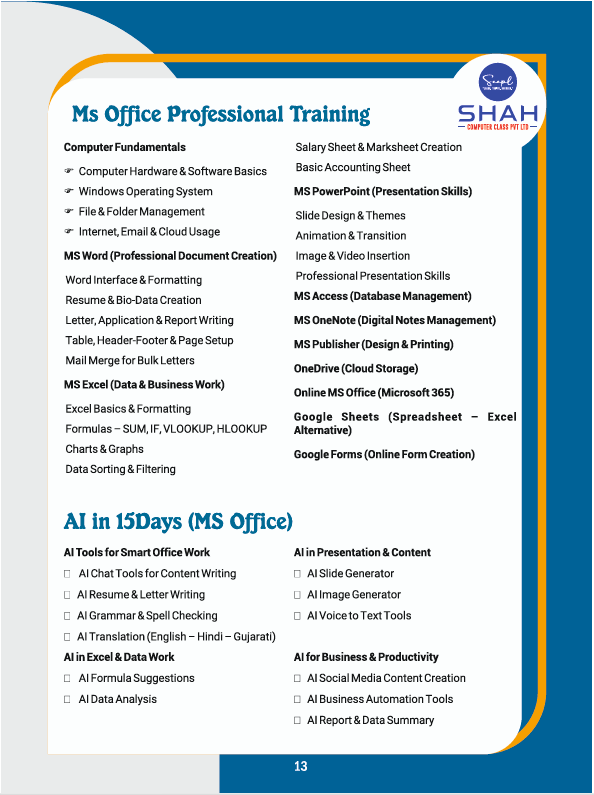 | 🔹 MS Office Course (Basic to Advanced) 🔹 MS Office Course (Basic to Advanced) ₹7000 Learn MS Word, Excel, PowerPoint and office tools for daily professional work. Ideal for students and job seekers. View product → |
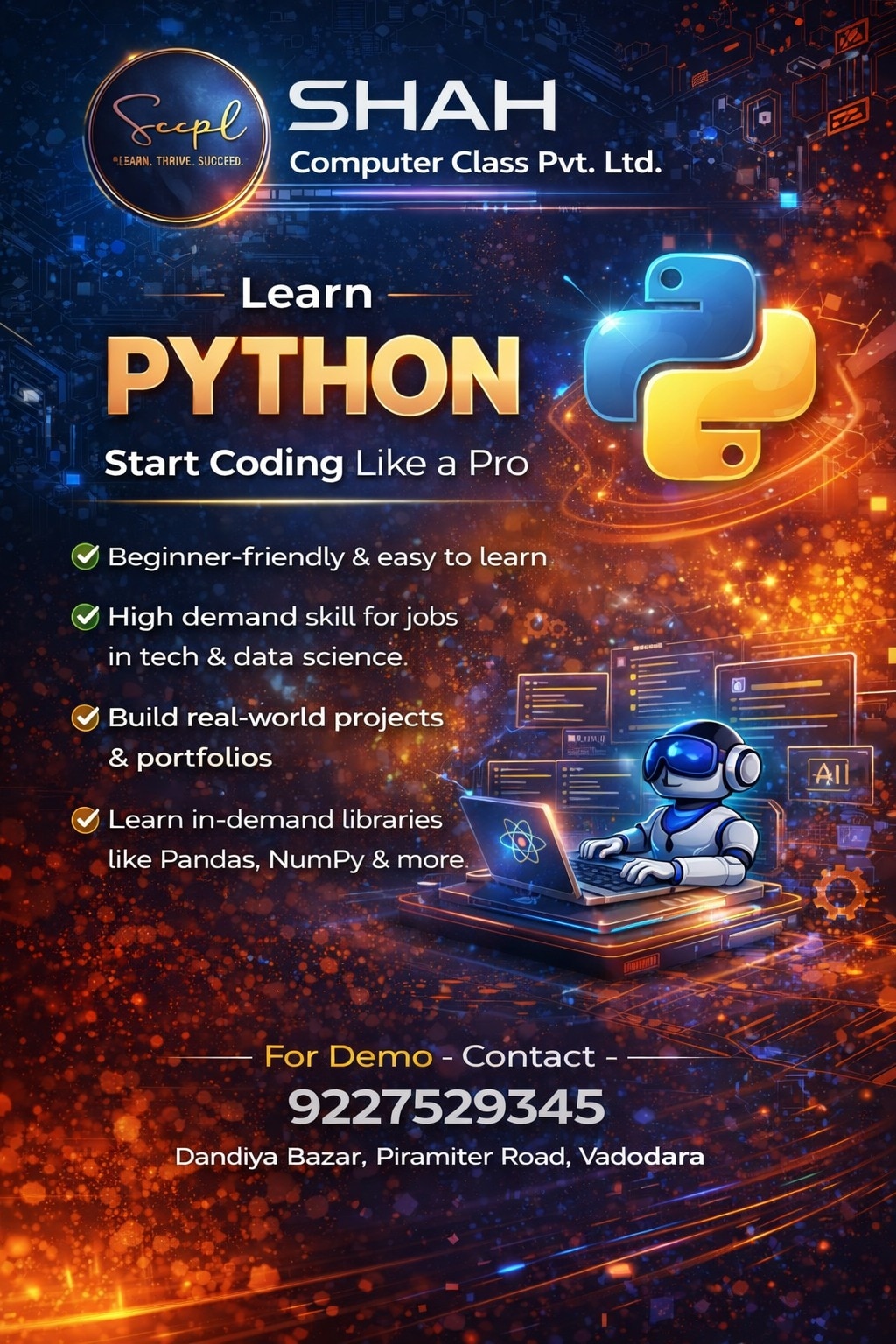 | 🔹 Python Programming Course (Beginner to Intermediate) 🔹 Python Programming Course (Beginner to Intermediate) ₹12000 Start coding with Python programming. Learn basics, data structures, file handling, and real projects. Ideal for students and beginners. View product → |
How should you judge the outcome against other learning routes?
A C, C++ or Java fundamentals course offers structured practice, instructor feedback and a portfolio starter, not a computer science degree, coding bootcamp or professional experience.
| Route | What it adds | Limitation |
|---|---|---|
| Fundamentals course | Guided exercises, reviews and starter projects | Limited depth and duration |
| Computer science degree | Algorithms, operating systems, databases, networking, software engineering and assessed projects | Several years of study |
| Coding bootcamp | Intensive teamwork and interview preparation | Faster pace and narrower coverage |
| Self-study or single-language tutorial | Flexible, cheaper learning | You design the syllabus and find feedback; testing, debugging, version control and project design are often missing |
Call yourself job-ready only when you can build, compile, test, debug and explain a small application without copying a demonstration. That is the practical measure of programming course outcomes, not attendance or a certificate.
Choose one language as your main track and finish its projects before adding another. For placement preparation, add data structures, algorithms, SQL, Git and mock interviews. Add electronics and microcontroller tools for embedded work, or HTTP, databases and API testing for Java backend roles.
Frequently asked questions
Which language fits your programming goal?
Choose C for procedural programming, memory control and native compilation; C++ for abstraction with performance; and Java for managed memory and JVM-based applications.
What should a C, C++ and Java syllabus actually teach?
Check for variables, control flow, functions, arrays, pointers, object-oriented programming, memory management, exceptions, collections, file handling and testing.
What software setup and debugging practice should you receive?
Verify that you will install and use compilers, IDEs, the Java Development Kit, build tools, debuggers and version control while fixing real program errors.
Which projects and assessments prove that you can code?
Look for complete projects with source code, documentation, testing and demonstrations, plus code reviews and timed assessments that measure independent problem-solving.
What course format should you verify before enrolling in Manjalpur?
Ask about class size, practical hours, lab access, missed-class support, instructor feedback, project supervision and the exact assessment schedule.
Related product
 | 🔹 Data Analytics Certification Course 🔹 Data Analytics Certification Course ₹54000 🔹 Data Analytics Course Become a skilled Data Analyst with our industry-focused Data Analytics Course designed for students, job seekers, working... View product → |